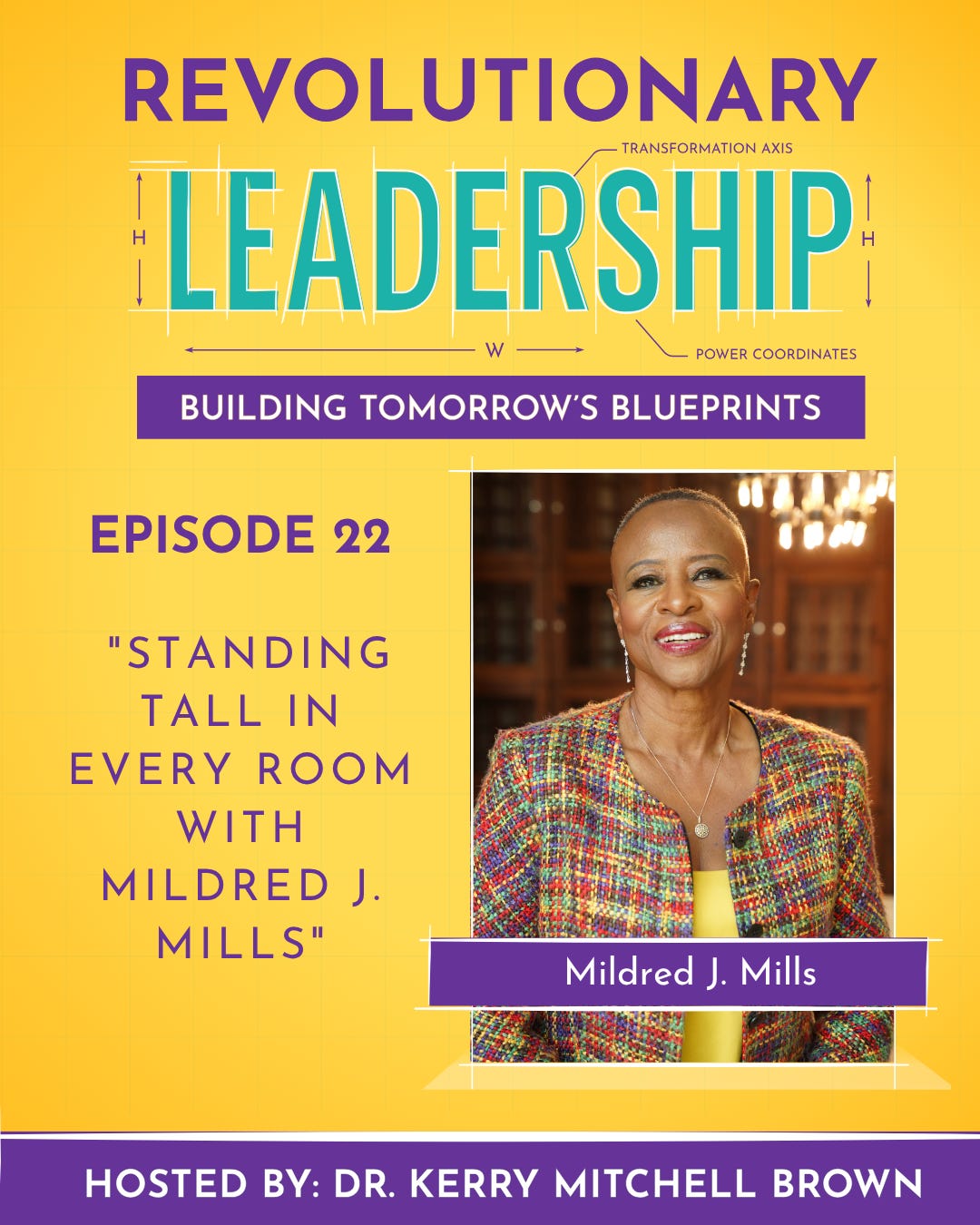
Mildred J. Mills was 25 when she bought her first house. She had just gone through a divorce. A friend came to see the place and said she didn’t know a woman could buy a house. Mildred looked at her and gave the line that opens this episode: “I didn’t know I couldn’t buy a house, so here we go.”
I sat beside Mildred at a screening in Chicago, and that sentence has stayed with me. It is a small line with a large idea inside it.
Nobody had told her no clearly enough to make her stop, so she kept moving.
Conventional wisdom says leaders are made in corporate offices, with a title, a mentor, and a clear ladder to climb. Mildred grew up on a 60-acre cotton farm in Alabama, the third of 17 children. When she entered the work that was then called data processing, nearly everyone in the room was a man. She describes it simply: it was her and the white guys. What surprised her was how nurturing many of them were. What did not surprise her was her father. He walked into a room and his presence demanded respect, and he taught her to expect the same. “I never ever felt that I didn’t belong in any room that I walked into.”
Leadership was never a corporate invention. Black women have practiced it at kitchen tables, on farms, and in rooms no one planned for them to enter, long before anyone printed it on a business card. Mildred’s mother gave her a phrase she still hears in her head today: “Do the best you can with what you have right now.” Her mother has been gone for almost 20 years. The words are still doing their work.
When a traditional publisher gave Mildred a soft no, she did not accept it as the final word. She published under her own imprint. Her father lived to 94, and in his 90s he was still driving a tractor and planting a garden. She thinks about him every morning, and that is part of why she keeps building.
Four principles came out of this conversation for the leaders who come after us.
Stand in your power. Walk into any room, even one that was not built for you, knowing you belong there.
Do the best you can with what you have right now. Don’t wait for perfect conditions or for permission. Start with what is in your hands.
Build intentionally. Mildred grew up around farming, where knowing when to plant, what to plant, and when to change crops decides the harvest. Build with that same discipline, and be willing to change crops when the soil needs something different.
Tap into the village. You don’t have to carry everything alone. Mildred’s advice to the next leader is direct: “You can’t eat the elephant all at once.” Then she adds the part that matters most: “You can’t do it alone.”
Mildred also made an offer every leader should take seriously: “Ask me questions. I’ll answer anything at this point in my life.”
Stand tall in every room. Then build the room the next woman will need.
About Mildred J. Mills
Mildred J. Mills was born the third of 17 children on a 60-acre cotton farm in Alabama. She built an IT career in corporate America, then chose a different path. She published her memoir, Daddy’s House: A Daughter’s Memoir of Setbacks, Triumphs & Rising Above Her Roots, under her own imprint, and she hosts the podcast My Cotton Patch Moment, where she explores resilience, healing, and transformation through real conversations. She lives in Atlanta with her husband.
Listen to the full conversation.
Wherever you get your podcasts, or at revolutionarylead.com.
Apple Podcasts • Spotify • Amazon Music • Castbox • YouTube
If this episode moved something in you, share it with one leader who needs to hear it.
Revolutionary Leadership: A Power Playbook for Black Women available now at revolutionarylead.com.
Listen to the podcast on Apple Podcasts, Spotify, Amazon Music, Castbox, or YouTube.
Join The Blueprint Circle — founding membership $120 for life, capped at 100 members. After that, it closes permanently. revolutionarylead.com