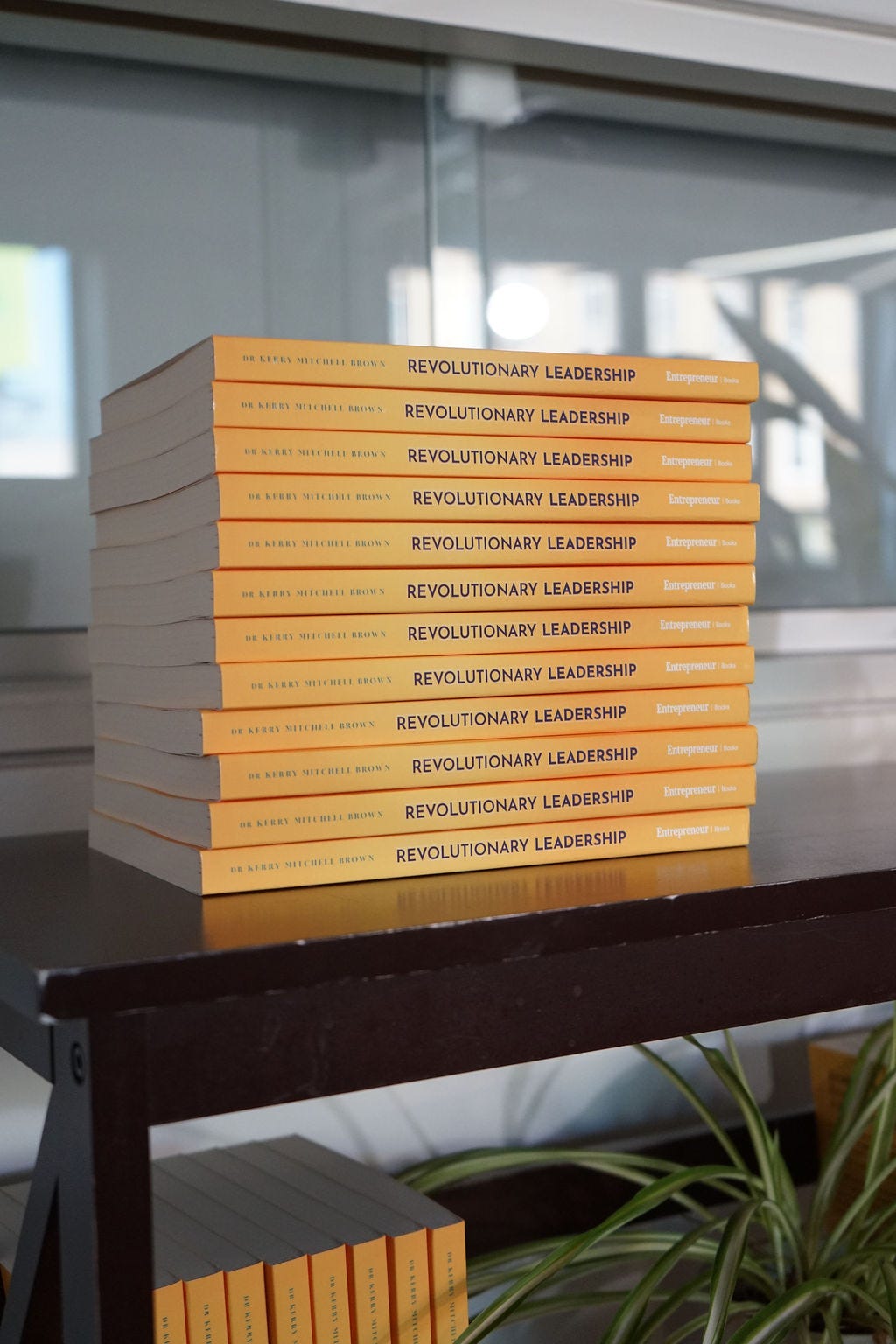
The book has been out for a month.
In that month, I have sat across from five very different rooms. A national women’s political network on a Sunday night. A drive-time public affairs show on KBLA. A magazine that has been documenting Black excellence for decades. Entrepreneur, four times. A podcast under the Forbes labels umbrella.
Every one of those conversations was framed differently. The hosts came in with different questions, different audiences, different disciplines. What kept happening across all of them is what I want to name here.
The same argument kept surfacing. Not because I brought it. Because the rooms brought it back to me.
The argument is about the instrument. The one that was built to measure a kind of leadership Black women were never in the room for. The one that keeps failing to read what we are actually doing. The one that a lot of us have stopped waiting on.
Here is where the book has been received so far, and what each conversation surfaced.
Win With Black Women, Sunday July 12
Jotaka Eaddy called me back to the room. She is the CEO of Full Circle Strategies. She built Win With Black Women to be the infrastructure it is now, and she invited me into it on a Sunday night when more than 1,600 women were on the call live.
I told the room something I want to say publicly again. To Jotaka, and to every woman who has built and sustained not a call, but an infrastructure of Black women with Black women. To be counted as a part of that means more than I can say.
The framing Jotaka set was the one that stayed with me. She said this show and this book felt divine when she looked back at how the whole evening had built itself. That is not a small thing to say about a book. It is a way of naming that the work fits inside a longer arc.
What I told the room about the book is that it is a door, not a destination. I am building an instrument. A way to measure how we actually lead. Not the way institutions have decided we lead, but how we do it. Care as competency. Community as infrastructure. Collective power. Finally with a number institutions cannot argue with.
Then I asked the room something. I called it Open the Room. Tell me your name, your email, one room this work belongs in, and how you might help open that door. Because I told them the truth. The book is a door. I cannot walk through it by myself.
The rest of what happened that night is in the recording. It stays with me.
Watch: youtube.com/watch?v=Kcsvp2r0C0s
A More Perfect Union on KBLA, Tuesday July 7
Dr. Nii-Quartelai Quartey hosts A More Perfect Union in the KBLA afternoon drive-time slot. Executive produced by Tavis Smiley. The show is public affairs at national scale, and Nii-Quartelai runs it as such.
He opened by asking where the instinct to seek permission comes from and how to unlearn it. I told him plainly. We are not waiting to be validated. We are the validators.
Then he took us into Harriet Tubman.
The version we have been handed is a gentle woman who quietly led folks to freedom. Turn the lens. She ran intelligence. She read terrain. She timed nineteen missions inside hostile territory against people hunting her for money. She was a commander, not a caretaker. Every woman who has ever built a back channel, or found a new way in when the front door was locked, is running the same play. We have just stopped calling it what it is.
Near the end, Nii-Quartelai asked me what I would want younger women to hear, the ones who might be the only one in the room. I told him that we do not rise alone. We rise connected. The women who thrive built webs, not ladders. Individualistic leadership is exhausting and isolating. It is not liberating. Reach out. Reciprocate. Practice friend-raising the way we already practice fundraising, because sustainability requires people who lift you up and who tell you the truth when you need to hear it.
Listen: youtube.com/watch?v=DwKFlVd3w9o
Heart & Soul, July 3
Heart & Soul has been documenting Black excellence and Black women’s leadership for years. When they invited me in, they asked the questions that let me name the source of this work publicly, without hedging.
I told them about the moment that made me write the book. A consultant stood at the front of a conference room and presented care, community, and collective problem-solving as the future of leadership. Executives wrote it down like scripture. I had watched Black women lead exactly that way my entire career. Nobody wrote us down.
That gap is the book. Not resentment. Correction.
Care is a competency, not a soft skill. Community is infrastructure, not sentiment. Well-being is an outcome you design for, not a prize you earn after you break.
They also asked what I want readers who are questioning their own power to take away. Here is the line I gave them, and I want it here too. If you are questioning your power right now, maybe because the job ended, or the funding vanished, or the door you earned closed anyway, hear this. The doubt was installed in you. It is not the truth about you. You descend from women who built working systems inside conditions designed to defeat them. That capacity is not a hope. It is your inheritance, and no institution can lay it off.
Read: heartandsoul.com/books/heart-soul-magazine-interview-with-dr-kerry-mitchell-brown
Entrepreneur, four articles across July and August
Four essays on Entrepreneur this summer. Each one runs a piece of the book’s argument at a different angle, into a business media audience that is not always ready for the framing but keeps clicking.
On why reliability quietly sabotages ambitious leaders. On the invisible tax every Black woman in leadership is paying, and how the ones who sustain success stop paying it. On the four-question audit for the women who are praised but not promoted. On the five things high-performing women keep doing that keep them exactly where they are.
All four are the argument moving through business media in shorter form. They are also a way to test what lands when the audience is not primed for the source material. So far, more than the framing usually admits.
Read all four: entrepreneur.com/author/dr-kerry-mitchell-brown
Advantage Media, in August
Joe Partabila and I had a real conversation on the Authority Company podcast, under the umbrella of the Forbes labels. The episode is worth its own treatment, which is coming later this month. For now, it is on the record.
What I Am Watching
The book has been received in five very different rooms, on five very different terms. Every host framed the conversation their own way. Every audience came in from a different angle.
The argument that keeps landing is the one about the instrument. About the ruler that was never built to measure what Black women are actually doing. About what happens when you stop asking to be seen inside a system that does not know how to see you, and start building the thing that does.
That is the argument the book carries. That is the argument these rooms handed back to me. And it is the argument Season Two of the podcast is now moving chapter by chapter through the book, starting last Thursday with Harriet Tubman.
If a system was not built to measure you, the problem is the ruler. Not you.
Build your own instrument. Then hand it to the next woman standing where you used to stand.
Lead with Power. Lead with Care. Change Everything.
I’m Kerry. Thanks for reading. If this landed for you, subscribe to keep going deeper — new pieces every week.
Revolutionary Leadership: A Power Playbook for Black Women available now at revolutionarylead.com.
Listen to the podcast on Apple Podcasts, Spotify, Amazon Music, Castbox, or YouTube.
Join The Blueprint Circle — founding membership $120 for life, capped at 100 members. After that, it closes permanently. revolutionarylead.com